Scalability
From small cranes with shallow draft, to large cranes with deeper draft.
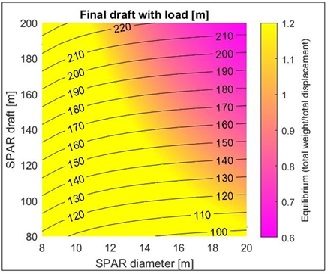
The concept is fully scalable, as the weight and lifting height is dictated by the diameter and draft of the Spar element. The current development is centred around a next generation, deep water, floating wind farm maintenance vessel. This vessel would be able to maintain wind turbines up to 20MW, with a single lift capacity of around 1,000t, to a height of 160m and a reach of 50m. It would operate in water depths greater than 80m.
Comparable CAPEX Cost
Estimated lower CAPEX costs than a large Jack-up, but without the same limitations.
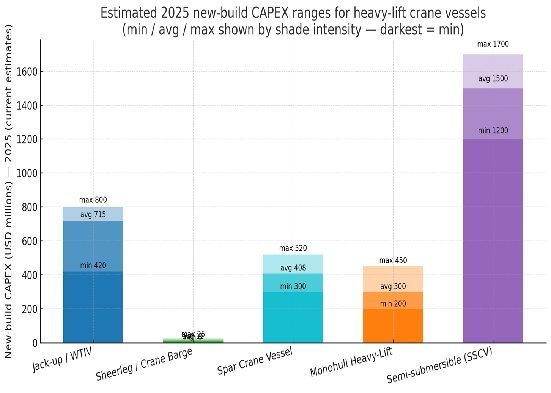
The cost for a new build vessel is likely to be similar to that of a modern monohull crane vessel of a similar size and specification, and estimated to be lower than a modern equivalent spec jack-up. However the spar crane vessel would have a higher poor weather availability and be able to operate in water depths in excess of 80m.
Higher Availability /Lower OPEX Cost
Operation in higher sea states, equates to less downtime due to weather conditions.
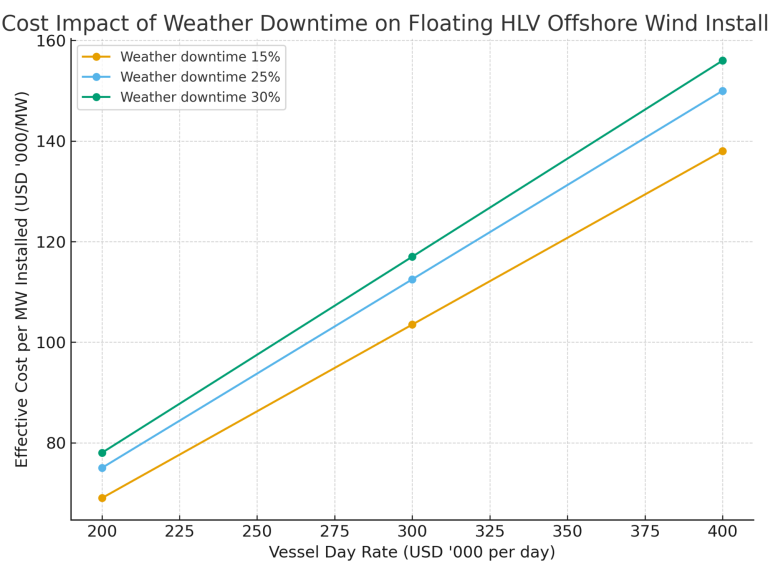
The deployment of vessels is recognised as a major cost factor throughout the lifetime of a wind farm. Assuming a day rate of $300k, a moderate sea state downtime of 25%, and an average install time of 6 days per 20MW wind turbine, the potential savings for a 500MW wind farm by using a more weather resilient crane vessel, could be as much as $11m. With regard to the operational period of a wind farm, the deployment of vessels is crucial to guarantee access for maintenance activities, vessel-related costs account for almost 45% of the total O&M cost, which could be reduced to 38%.
Inherently Safe System
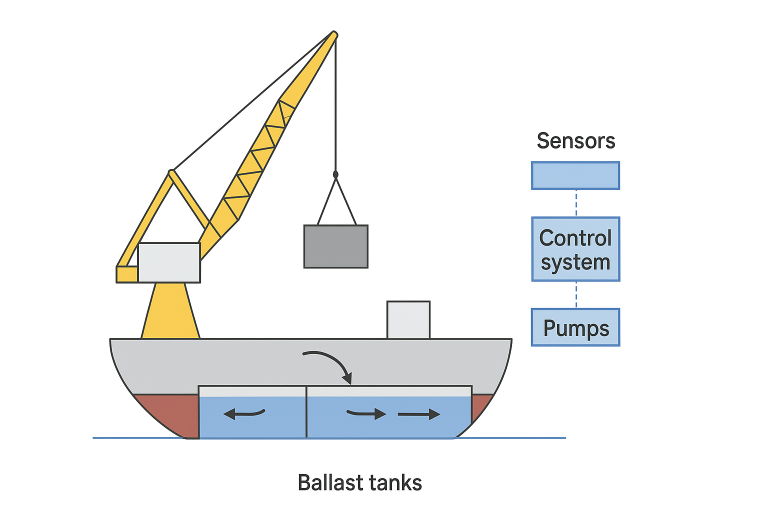
Operational stability not dependent on hydraulics, dynamic ballasting of water between tanks, or other electro/mechanical systems.
Unlike the smaller hydraulic motion compensating cranes and the larger monohull water ballasted crane vessels, the concept's crane Spar platform, once deployed, would not be reliant on dynamic ballasting. There may be a trim adjustment required, depending on the load being lifted, but if a there was a sudden loss of load from the hook, the Spar would absorb the shock and the vessel would be unaffected.
Option For Vessel Conversion
Existing vessel conversion could provide a lower cost option, with a quicker rout to operation.
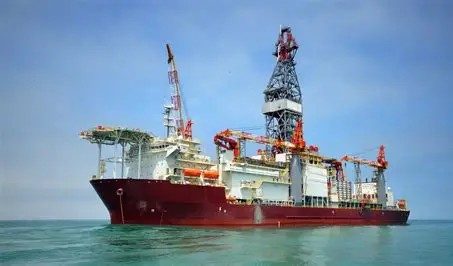
The repurposing / conversion of existing vessels is an option which could provide an extremely low cost and quick to market solution. Disused drill ships could be particularly suitable vessels for conversion, as they usually already have a moonpool and a dynamic positioning system. In addition to the obvious cost savings, there would also be considerable carbon emissions savings, when compared to a new build vessel.
Variations And Spin-offs
Combined crane and motion resistant deck vessel and an all-in-one option.
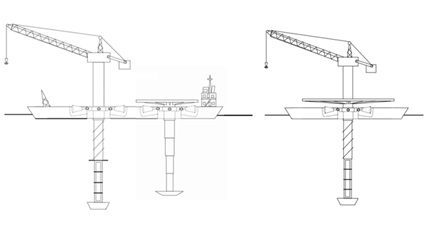
The patent family includes a number of related spin-off variations. These include a combined crane and motion resistant deck supply / installation vessel, an all-in-one crane and component support deck. There is also a Telescopic Spar floating wind turbine foundation, and a specialist deployment vessel for these foundations with their turbines pre-installed.
Other information.
Additional large markets for scalable growth: More and more countries are committing to offshore wind energy, DNV forecast that 289 GW of offshore wind will be installed by 2050. As a majority of suitable offshore sites around the world are in water depths of over 60m, this presents a huge market for deep water capable installation and maintenance vessels. In addition to the wind industry, large heavy lift crane vessels are in demand for installation and decommissioning operations for the oil & gas industry, as well as salvage operations. Other related spin-off concepts for wind turbine support platform, its deployment vessel and supply vessels also exist.
Competition: there are a number of specialist lifting vessel concepts being developed by others, but most of these are designed for a single function or do not have the versatility of the proposed concept. Furthermore, most of the other concepts still have similar operational limitations to the equipment already available. There are also below hook heave compensation devices available, these are for use on conventional crane vessels, but these only compensate for the heave motion and not the roll and pitch. They are also limited by the operational limitations of the crane vessel to which they are attached.
IP Status: 20 years plus protection with patents pending in the UK, Europe, South Korea, China, Japan and the USA. Further patent applications are likely to be made during the concepts further development. This provides options for international licensing, sale or rent. NDA’s in place with some potential partners, staff and agents. Web domains owned.
Product status TRL 3 - 4: With academic partners at the University of Strathclyde, completed 2 initial feasibility and hydrodynamic studies. These studies looked at preliminary scoping, sizing, hydrodynamic interactions, and cost.
Funding to date: The concept development to date has been funded by the founder, an Innovate UK grant and a Newhaven Enterprise grant. The project has also been supported and studies undertaken by the University of Strathclyde, Department of Naval Architecture, Ocean & Marine Engineering.
Further grant funding is likely to be available.
A CORPORATE PARTNER, CO-DEVELOPER AND INVESTOR IS NOW SOUGHT TO FULLY COMMERCIALISE THE DESIGN. IN RETURN, A LICENSE TO MANUFACTURE AND MARKET THE CONCEPT AND ANY SPIN OFFS WOULD BE OFFERED AND / OR AN EQUITY SHARE (SUBJECT TO AGREEMENT).
Any parties interested in this opportunity, please contact the founder via the contact page or email address on this website.